
Fixed teeth without bone grafts — even if you've been told you don't have enough bone. Advanced cheekbone-anchored implants for severe upper-jaw bone loss.
Many patients who lost their teeth years ago are told they can't have dental implants because the upper jaw has shrunk too much. In the past that meant extensive bone grafting or sinus lifts — adding months or even years to treatment.
Zygomatic implants change that. These extra-long implants (30–55+ mm) anchor into the zygoma — your cheekbone — which is naturally dense, stable and highly resistant to bone loss. The concept was pioneered by Professor Per-Ingvar Brånemark, the father of modern implant dentistry, and published long-term survival rates generally exceed 95%.
At Dentfix Istanbul, our experienced surgical team plans every zygomatic case on 3D CBCT imaging and performs it with a multidisciplinary team — restoring fixed teeth for patients previously considered "untreatable".
Get my free evaluation →Zygomatic implants are designed for patients with severe upper-jaw bone loss — especially if you've heard any of these before:
Severe upper-jaw bone loss or long-term complete tooth loss — the cheekbone anchor makes implants possible anyway.
Zygomatic implants usually avoid grafts and sinus lifts entirely — cutting a year of healing out of your treatment.
Failed previous implants or grafting, extensive sinus expansion, gum-disease damage, trauma or congenital defects.
In many of these situations they aren't — send your X-ray or CBCT and our surgical team will tell you honestly.
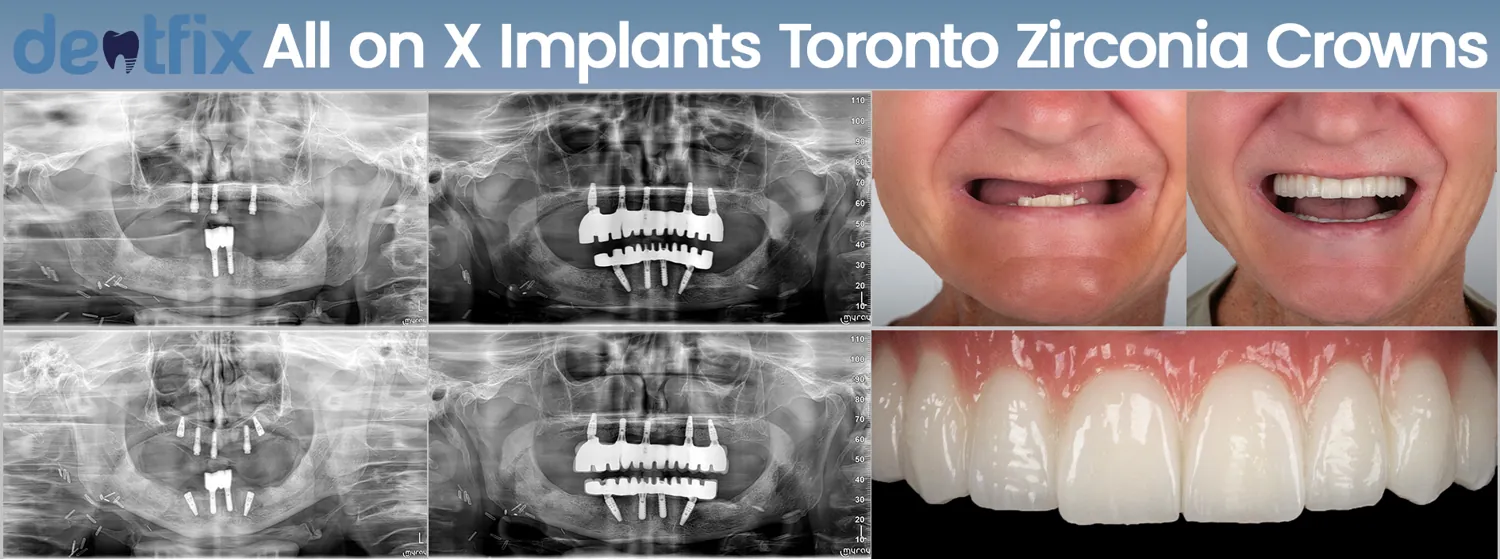
Every case below was treated at Dentfix Istanbul by our surgical team. The panoramic X-rays show the zygomatic implants anchored in the cheekbone. Tap any case to view it enlarged.
All photos show real Dentfix patients, published with their consent. Top row: before · bottom row: after. Individual results vary — candidacy is confirmed with a CT scan.
After a tooth is lost, the bone around it gradually shrinks — and in the upper jaw the maxillary sinus expands downward over time, leaving even less bone. Gum disease, long-term denture use, trauma, aging and smoking all accelerate this.
Instead of relying on that weakened jawbone, the zygomatic implant is carefully angled and anchored into the zygomatic bone (cheekbone) — which is extremely dense, very stable and highly resistant to resorption. That density means excellent stability without grafts, and in many suitable cases a fixed temporary prosthesis shortly after surgery, so you're not left without teeth while healing.
Depending on your anatomy, our surgeons may combine conventional implants, zygomatic implants and pterygoid implants — from a hybrid arch to a "quad zygoma" (four zygomatic implants) for extreme bone loss. Every plan is designed individually after clinical examination and 3D CBCT imaging.
Usually eliminates grafts and sinus lifts — and the 4–9 months of graft healing that come with them.
In many suitable cases a fixed temporary bridge is placed shortly after surgery — immediate function.
Published long-term survival rates generally exceed 95%, with experienced centers reporting 97–98%.
Surgery + temporary teeth on the first visit; final monolithic zirconia prosthesis after 4–6 months.
1 · Free online evaluation. Before you travel, our medical team reviews your panoramic X-ray, CBCT scan (if available), medical history and photos — and tells you honestly whether zygomatic implants are right for you.
2 · Clinical examination in Istanbul. Comprehensive examination, digital smile analysis, a new CBCT scan if required, and final confirmation of your plan.
3 · Surgery. Extractions (if needed), conventional + zygomatic implants placed under intravenous sedation or general anesthesia by our surgical team.
4 · Temporary teeth. Whenever clinical stability allows, you leave with fixed temporary teeth — smiling through the healing period.
5 · Final zirconia prosthesis. After ~4–6 months you return for your final restoration — we frequently recommend monolithic zirconia with titanium-bar reinforcement for exceptional strength and aesthetics.
Zygomatic surgery is considerably more complex than conventional implant treatment — it demands advanced surgical knowledge, deep understanding of facial anatomy, digital planning and a multidisciplinary team of surgeons and prosthodontists. That experience is exactly what Dentfix was built around: it improves both safety and long-term success. Read more in our complete zygomatic implants guide, or compare with All-on-4 / All-on-6 and conventional dental implants.
A multidisciplinary team led by senior clinicians.
Clear timelines so you know what to expect.
A personalized quote — no hidden costs.
Coordinators in 9 languages.
Specially designed extra-long implants (typically 30–55+ mm) that anchor into the zygoma — the cheekbone — instead of the upper jaw. Because the cheekbone is extremely dense and resistant to bone loss, they support fixed teeth even after severe bone resorption.
If you have severe upper-jaw bone loss, long-term tooth loss, failed implants or grafts, extensive sinus expansion — or you've simply been told "you don't have enough bone" — you may be exactly who this treatment was developed for. Send us your X-ray or CBCT for a free candidacy review.
In many cases, no. Avoiding grafts and sinus lifts — and their months of healing — is one of the main advantages. Treatment can often be completed in two clinical phases.
Yes — with experienced surgeons, modern 3D planning and proper patient selection, they have an excellent safety profile backed by decades of clinical evidence and published survival rates generally above 95%.
Most patients report less discomfort than expected. Surgery is performed under IV sedation or general anesthesia; mild swelling and bruising in the first days are normal and managed with medication.
In many suitable cases you receive fixed temporary teeth shortly after surgery. The final monolithic zirconia prosthesis is fitted after approximately 4–6 months of healing on a second visit.
Send your X-ray or CBCT scan — our surgical team reviews it and replies within 24 hours. Free, no obligation.
Zygomatic Implants Cost · Told You Do Not Have Enough Bone for Implants? Here Are Your Options · Zygomatic Implants vs Bone Grafting · Zygomatic Implant Recovery · Zygomatic Implants in Turkey